Wednesday, 14 June 2017

The cost of being successful?

June 2nd 2017 is a date that perhaps rubber-stamped a power-shift in Irish football. Champions for the past three seasons Dundalk faced a must win game with runaway leaders Cork City at Oriel Park. The end result was a damaging 3-0 defeat that realistically bought an end to any title hopes for the Lillywhites. It a defeat that felt more too, almost like a shift in power, such was the manner of City's win which opened up an eighteen point lead at the top.

The following morning however bought City back down to earth and that familiar feeling of being successful in Ireland as Seani Maguire, the hat-trick hero in that 3-0 win, had his transfer to Preston North End confirmed. The rumoured fee is €150k with a few additional clauses put in with City at least securing his goal scoring services up to the end of July. This means Maguire will be available for two full Europa league rounds, should City progress, which is worth more than twice the transfer fee.
Having secured Maguire, the league's top scorer this season for a paltry sum, Preston have set their sights on City left-back Kevin O'Connor. The cost of being successful?

Well Dundalk know that themselves. Their European exploits last season put not only the club in the spotlight but the players as well. Centre-back Andy Boyle and flamboyant winger Daryl Horgan both joined Preston on free-transfers after the conclusion of Dundalk's Europa league campaign. That coming a year after losing goal scoring midfield Richie Towell to Brighton.

Unfortunately these transfers are commonplace in the league of Ireland. The major factor behind these is the weak financial positions of all the clubs. Clubs are only in a position to look ahead just one season and thus in the main only offer one year deals to players. Only the likes of City, Dundalk and Shamrock Rovers offer anything longer in the main. Promising young players are advised to sign one year deals by agents which strengthen their position in moves across the Irish sea.

Cork City's season has put them in the spotlight and any run in Europe this summer might attract more clubs to the other star performers. For City, such is their lead at the top of the league they realistically have it won which brings its own financial rewards with champions league football. That virtual guarantee should be attractive to potential Maguire replacements.

So far Preston seem to be the only English club looking around the league of Ireland for players on the cheap this summer. In the past players moving to England have had various degrees of success and failure. Brighton for example haven't been able to see the player Towell was at Dundalk while Preston's Horgan and Boyle have settled well.

The cost of being successful in Ireland has always been losing players to British clubs. The lack of revenue dictates that. Even if the league had a solid financial clout it would be in similar situations to many leagues outside of Europe's top three-four where selling players is the norm.
Shelbourne's 2004 European run saw them lose Wes Hoolohan to Scotland's Livingston for £123k. St Pat's lost their prized asset in Chris Forrester, Derry City going back to Niall McGinn and James McClean and of course Cork City who lost Kevin Doyle midway through the 2005 league winning season. The problem even back when the league was healthier is getting decent fees for players.

A stronger contract situation would ensure clubs get a somewhat decent transfer fee but that comes with stronger finances which is also no guarantee as seen in the early 2000s. Club's were in a healthier financial position and had stronger contracts and still lost the likes of Seamus Coleman, James McClean and Shane Long for minuscule amounts.

Friday, 2 June 2017

Russia's far east

The curtain was bought down on the National football league, the second tier in Russian football last weekend. The second leg of the promotion play-offs between two Premier league sides and the third and fourth placed national football league teams took place. One of those second tier sides was SKA Khabarovsk. A team unfancied that had in recent years cemented their place in mid-table in the second tier. The club are based in the far eastern city of Khabarovsk and had never graced the top tier, until now.

SKA Khabarovsk by finishing fourth entered the promotion/relegation play-off with FC Orenburg who had finished 13th on their inferior head-to-head record with Anji Makhachkala. The first leg was held in Khabarovsk's Lenin Stadium to see a nervy 0-0 draw. A positive result given they prevented their higher placed opponents scoring an away goal. 

The second leg was equally as nervy, three days later and some 7,300 km away from home. Extra-time came and went without either side's net bulging as the lottery of penalties loomed large. Just under 7,000 in attendance were to witness the men from the east secure a first ever promotion into the Premier league with a 5-3 win in the shoot-out. The winning penalty being dispatched by Ruslan Koryan after Andrei Malykh had the misfortune to be the only player in the shoot-out not to convert for his side. 

That promotion bought SKA Khabarovsk into the world media. Unfortunately it wasn't much to do with their shock promotion from mid-table to promotion in twelve months but to do with their geographic location. SKA being based in Khabarovsk are less than 30 miles away from the Chinese border and this season were one of just two sides from the far eastern corner of the country to participate in the second tier. 
With the relegation of Siberian side Tom Tomsk from the Premier league next season SKA will be over 6,500 km from their nearest opponents in FK Ural from Yekaterinburg. Their furthest trip incidentally will be to Zenit's new Krestovsky stadium which is 8,850 km away from SKA's home. 

SKA's promotion means they are the first far eastern team to play top tier football in Russia since 2008 when FC Luch-Energiya, based even further away in the port of Vladivostok, were relegated after finished bottom of the league. Luch-Energiya were despised by many of their Western opponents based purely on their geographic location. Complaints about the distance were plentiful and got particularly nasty when CSKA Moskva's Igor Akinfeev remarked about the club by saying "they should play in the Japanese league". That after Luch had torn into CSKA 4-0 in Vladivostok in 2007. 

However SKA's promotion isn't a sign that football in the far east is booming, far from it in fact. As stated SKA will be the first side from the region in the top tier in nine years. While SKA were celebrating their unlikely promotion, down the road (in jest of course, it's 750 km away), Luch-Energiya were coming to terms with their relegation to the third tier (on the pitch, there is suggestions that they will replace FK Chita in the second tier next season). This relegation being their second into the third tier since their top flight relegation in 2008. 
SKA will be just the third different side to play top level football from the region since the break up of the Soviet Union. The first side was FK Okean Nakhodka who to date remain the furthest eastern team to ever play in a top flight European league but are also no longer in existence having been liquidated in 2015. 
Even the second tier has been sparsely represented in recent years. There was the 2014-15 season where SKA and Luch were joined by FC Sakhalin from the Sakhalin Oblast which is located off the Russian mainland and above Japan's northernmost Hokkaido island. Amazingly FC Sakhalin took part in the second tier that featured Baltika-Kaliningrad and thus the world record for the longest domestic league game was set with 10,500 km between the teams. 
Teams from the region are always up against the geography. The Russian football federation did introduce a procedure to help ease the financial burden on the travel costs to and from the region a few years back. This was to group both SKA and Luch into one long haul journey, so for example, some teams out west would play Luch away and then a few days later play SKA away before jetting back west and likewise for SKA and Luch to play two away games in quick succession before flying back east. This being done a couple of times a season to cut the air miles slightly.

Challenge to stay up:
SKA's challenge is now to stay in the top flight. Doing so will of course be difficult for obvious reasons. The blueprint for them can be how Luch stayed in the top flight for two full seasons in the 2000s. In Luch's first season back in the top flight in 2006, they amassed twelve victories, eleven of which came at home. The following season they narrowly avoided the drop. This was in no small part achieved by their seven home victories. Of the thirty-two points collected that season, twenty-six were gained at home. The blueprint is clear for SKA, make the home advantage count. 

Wednesday, 24 May 2017

Everything has to end sometime

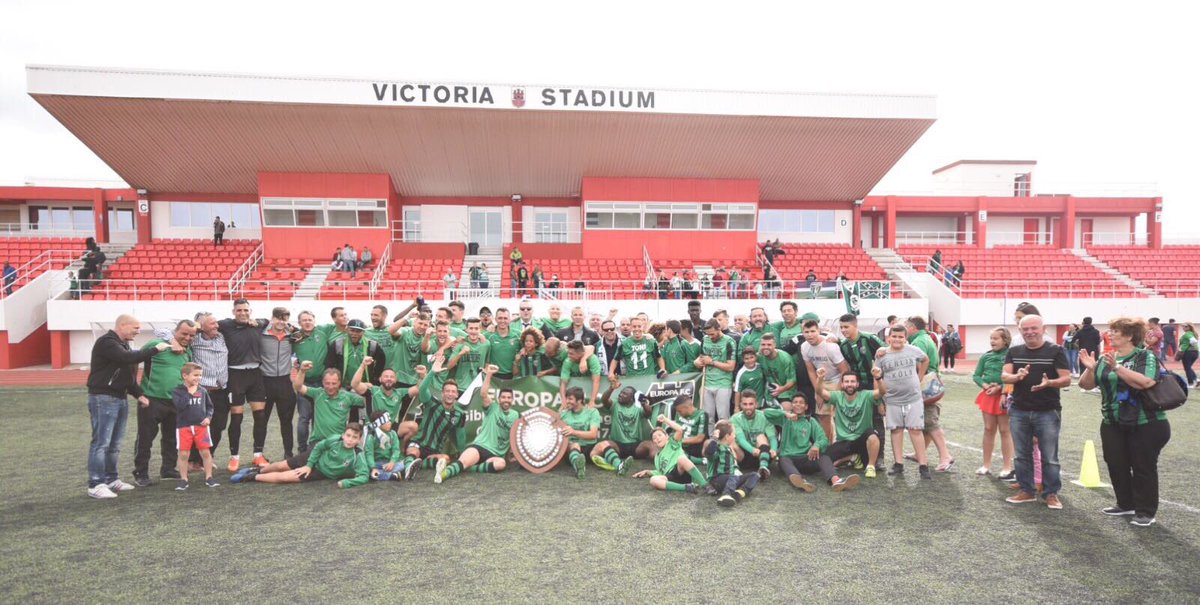
This past weekend three long standing periods of domination were finally put to bed. One by one over the weekend they fell from Albania to Gibraltar via Croatia. A sense of new life being pumped into these leagues as seen with the celebrations after the final whistles blew. In the cases of Kukesi and Rijeka it was first ever league titles, for Europa FC first title in a lifetime.

Albania:
Kukësi celebrate their maiden championship
source: rtsh.al
On Saturday FK Kukësi dethroned champions for the past six seasons Skënderbeu Korçë. They secured it with a 2-0 home win over the outgoing champions with a brace from Croatian striker Pero Pejić. Those goals took his tally to twenty-six for the still unbeaten champions with one round remaining. The striker signed last summer from Esteghlal of Iran and has now won the Albanian title with three different sides (Kukësi, Skënderbeu Korçë and Dinamo Tirana).
Another key in the success was Enea Koliqi who kept twenty clean sheets along the way. For manager Ernest Gjoka it capped off a terrific first season in charge. For perspective, Kukësi last season were beaten nine times and finished third, sixteen points off the title.

Croatia:
Rijeka are Croatian champions
source: CROPIX
One of Europe's long standing periods of dominance is over after Rijeka maintained their superiority this season with a 4-0 dismantling of Cibalia sparking wild celebrations in the coastal city. The result ended any hope of Dinamo Zagreb extending their league streak to twelve and ensured a first ever league title for Rijeka. It caps a magnificent spell in charge for manager Matjaž Kek, under his stewardship has seen the club win the Croatian Cup and Super Cup along with two Europa League group stage appearances.
A storming run to the title was made possible with four players hitting double figures, Franko Andrijšević (fifteen goals), Alexander Gorgan (twelve goals), Roman Bezjak (eleven goals) and Mario Gavranović (eleven goals).

Gibraltar:
Europa FC celebrate their triumph


source: C Correa Photography


Lincoln Red Imps' run of fourteen consecutive titles is over after Europa FC took full advantage of the opportunity presented to them. A 2-2 draw between Lincoln and Mons Calpe a fortnight ago swung the title race back into Europa FC's hands and they made no mistake, winning both remaining games. It was their first title since 1952 and their seventh overall. Their title victory denied Lincoln what would've been a European record of fifteen titles in succession.
A major contributor to the success was no doubt the thirty-goal haul from Kike Gómez but also both Guillermo Roldán and Liam Walker hit double figures with fifteen strikes each. Manager Juan Gallardo in his first season in charge delivered a fantastic title win that saw Europa FC beaten only twice in twenty seven league games.

Thursday, 18 May 2017

FK Budućnost - An almighty collapse

In last week's post about title races I mentioned briefly how the title race in Montenegro had been reopened in recent weeks. I felt this warranted a post of it's own because of how it came to this stage of an open race, whereas only a few months ago FK Budućnost seemed to be pretty much nailed on for the title honours. 

FK Budućnost hail from the Montenegrin capital of Podgorica. Since the country's independence from Serbia in 2006, the club have won the league crown twice and have posted six runners-up placings. In the Yugoslav era the club reached the final of the Yugoslav cup in 1965 and 1977, losing on both occasions. Last season Budućnost lagged behind fellow capital side Mladost and last summer were a couple of spot kicks away from eliminating eventual Europa League quarter-finalists Genk. 

This season however is certainly worth talking about. At the beginning of the campaign Budućnost raced out of the traps with five wins from their opening five games. They wouldn't taste defeat until a 2-0 reverse at home to Rudar in October. Four wins from the next four league outings would extend their lead at the top of the table. A cup exit at the hands of Grbalj did put a dampener on the first half of the season however. A 3-0 win over Bokelj in the final game before the winter break got that cup disappointment out of their system. 

At the break Budućnost were eleven points clear of Mladost and seventeen ahead of FK Zeta and Sutjeska. Their record stood at played seventeen, won thirteen, drawn three and just one defeat. Manager Miodrag Vukotić seemingly guiding his side to a third league title. 

However there was a sensational collapse in the wings. The first two games back after the break yielded four points against Zeta and Sutjeska. However that victory over Sutjeska would be their only victory for two months and to date the team have only recorded two since.
Budućnost's record since the break has been a stark contrast to their record before the break. Played fourteen, won three, drawn three and lost eight. Goalscoring has dried up and the defence has become extremely leaky. Before the break they conceded just seven in total, they have conceded seventeen in the games after the break.

Radomir Đalović hasn't replicated his autumn form
Foto: Luka Zeković / Vijesti
Top goalscorer remains Goran Vujović with eleven and despite the team's collapse he has remained on some sort of scoring trail. Vujović has probably been the only player to retain some sort of form resembling the first half of the season. Radomir Đalović in total has ten league goals with just three coming after the break. Midfielder Milivoje Raičević has nine goals to his name, however he hasn't scored since December before the break. 

Amazingly their collapse hasn't nudged them off the summit, yet. Sutjeska sit two points behind them having made up fifteen of the seventeen point gap that existed between the two at the break. FK Zeta are a further point behind in third but would actually be two points clear but for a six point deduction for two separate cases of disciplinary breaches. 

Budućnost have two games remaining to crawl over the line but for a side that require two victories to guarantee the title but have only won three games since the new year, nothing is assured in Montenegro.

Wednesday, 10 May 2017

Grand Stand finishes around Europe

By now approaching mid-May many European leagues have already crowned their champions. However for some, there is some quite enthralling title races still to reach their conclusion. By enthralling, I mean enthralling, more than two sides going for the title with little between them.

Poland:
Jagiellonia are gunning for a first ever league title
source: Maciej Gilewski 
We'll start with Europe's closest title race in the Ekstraklasa. Six rounds of games still remain with the final round not scheduled until the beginning of June but it does translate into a month of knife edge action. A single point is all that separates the four title contenders with Jagiellonia Białystok lead Lech Poznań on the head-to-head record. Such is the compact nature of the league this season it could well be decided on the head-to-head. 
Two of the contenders, Jagiellonia Białystok and Lechia Gdańsk have never won the title which adds more suspense to this race. Defending champions Legia Warszawa, while in contention, are yet to reach the summit this season. Given that the league has split into two, the next few weeks are littered with head-to-head clashes between the contenders and this is certainly one title race to keep a close eye on. 

Moldova:
Moldova's Divizia Națională reaches it's conclusion in the next fortnight with just three points separating the top four sides. The twist in the race however, is leaders Milsami have already played a game more than their rivals. Milsami face a nervous weekend of inactivity while all three of their title rivals face home fixtures. Any win for any of the contenders will knock Milsami off top spot but should all three of Dacia, Sheriff Tiraspol and Zaria win then the final weekend will see just one point separate all four. To add even more twists, Milsami will face Zaria on the final day with Sheriff and Dacia away at relegation threatened sides. 

Montenegro:
An absolute collapse in form from Budućnost in 2017 has opened the title door to FK Zeta, Mladost and Sutjeska, with all three sides now within three points of the stuttering capital side. Four rounds of games remain and given the slump from Budućnost, the title slipping out of grip cannot be ruled out. The leaders also face all the title hopefuls in their remaining fixtures. To put a perspective on the collapse, Budućnost held a twelve point lead at the winter break. This is a race worth keeping an eye on to see if Budućnost can avoid a sensational bottle-job. 

Albania:
Over the border in Albania, the Superliga has been a constant three horse race all season. With four rounds left to play just a solitary point is all that is between FK Kukësi, Partizani Tirana and Skënderbeu Korçë. Champions for the past six seasons, Skënderbeu Korçë haven't been able to make top spot their own this season with surprise package FK Kukësi remaining in front for much of the season by the narrowest of margins. This midweek sees a round of games pencilled in for decision and the remaining rounds will be crammed in before May 27th's finale which has Skënderbeu Korçë hosting Partizani in a potentially massively defining fixture. 

Romania:
Over in Romania just one round remains in the Liga I title race. Three sides, Viitorul Constanța, FCSB and Dinamo București are seperated by two points. All three face home games this coming weekend with Dinamo needing a very unlikely set of results to claim the title. Viitorul are gunning for a first ever league crown and FCSB are looking to claim a first title since the acronym of FCSB was adopted seemingly permanently earlier this year. On paper Viitorul have the toughest assignment against CFR Cluj with FCSB hosting Universitatea Craiova and Dinamo at home to Astra Giurgiu. 

Other notable mentions
Gibraltar:
Both Lincoln Red Imps and Europa FC have been nip and tuck in the league for the entire season. Both are separated by a point with two games remaining. Lincoln hold the slender advantage but face third placed St Joseph's in a potentially tricky game. Europa FC need a slip up from Lincoln in their final two games while they themselves need to win both of theirs. 

Hungary:
A tight finish is in store with Honvéd and Videoton level on points with three games of the campaign remaining. As luck would have it they both face each other on the final day of the season on May 27th. Honvéd are at home and chasing a first league title since 1992-93 while Videoton are hoping to claim a third ever league title. 

Wednesday, 3 May 2017

The decline of RCD Mallorca

A quick glance at the bottom half of the Segunda división and you will find a couple of teams that graced La Liga for decent spells such as Almería and Rayo Vallecano. Look closer and you'll find RCD Mallorca second from bottom in serious danger of going down. It wasn't always this way.

Hailing from the capital of the Balearic islands, Palma, RCD Mallorca have spent a total of twenty-seven seasons in the Spanish top flight. They are ranked eighteenth in the historical classification and have by and large been the island's leading club. Their decline to their current mire has been slow and painful.

The 1998-99 season remains the club's best ever in terms of achievement. Under the guidance of Argentine coach Héctor Cúper, the islanders were runners-up in the final edition of the UEFA cup winners cup while domestically they finished third for their highest ever placing. A Supercopa de España trophy the following season marked the start of what was to become a golden period for the club. Cúper had departed for Valencia at this stage and under Luís Aragonés in 2000-01, Mallorca again finished third in La Liga. Unlike in 1999 where they failed to negotiate a path to the champions league group stage, in 2001 they made no mistake. In a group containing Arsenal, Schalke and Panathinaikos they finished third but narrowly missing out on progression.

Another trophy wasn't long coming for the club. The 2002-03 campaign didn't end until late June but the long arduous season was well worth the effort when, now under the guidance of Gregorio Manzano, they beat Recreativo de Huelva 3-0 in the Copa del Rey final in Elche. Goals from Walter Pandiani and a brace from Samuel Eto'o securing Mallorca's finest hour.

Leading players such as Pandiani, Eto'o and Alberto Luque would be sold off in the seasons following that Copa success. This resulted in a relative doldrum period where comfortable mid-table placings were the norm. Players being sold off was a common theme until the 2009-10 season. A season that saw Mallorca heavily involved in a champions league tussle with Sevilla. A late dip in form allowed Sevilla to pip them to the fourth champions league spot by a solitary point. A few weeks after the heartbreak, Mallorca were banned from taking part in European competition by UEFA for financial irregularities. That 2009-10 campaign was to prove as good as it got.

Mid-table and relegation battles ensued for the following seasons until they fell through the relegation trap door in 2012-13 on the final day. A relegation that ended a two decade spell in the top division. There would be no bouncing straight back up and their three seasons down in the second tier have yielded almost identical finished of seventeenth, sixteenth and seventeenth. Such mediocrity saw highly promising Marco Asencio depart for Real Madrid.

The current campaign is in serious danger of Mallorca slipping further down the pyramid. At the time of writing they are second bottom, six points off safety with six games remaining. Instability in the dugout hasn't helped with three different managers taking the helm. The current incumbent, Fernando Navarro is facing a massive challenge to keep the club up in the next few weeks.

Relegation would be a disaster for the club. Segunda B doesn't have professional status and the attendances at the Iberostar Estadi would plummet even further in the third tier. For the optimistic Mallorca fans perhaps some solace can be taken from Tenerife's experience. The Canary Islanders suffered back-to-back relegations from La Liga to Segunda B but a bounce back into the second tier has seen them build slowly into a side current challenging for promotion into La Liga once more.

The story of RCD Mallorca in the past twenty years could have yet another twist in the next few weeks and relegation also opens the prospect of Mallorca facing local rivals Atlético Baleares competitively next season. Not a prospect Mallorca fans would've envisioned when beating Recreativo in the Copa del Rey in 2003.

Thursday, 20 April 2017

How do newly promoted teams fare?

On Monday Brighton & Hove Albion rubberstamped their promotion to the Premier league. Their promotion has led to the annual questions and predictions of how will they fare next season. The cliche being that newly promoted teams always tend to struggle and go down. A perceived gulf between Premier league and football league in terms of finance is a major factor in how well or poor teams do. Brighton now have access to the cash bonanza that is the Premier league TV money. So just how do newly promoted teams fare in the season after promotion. For this I examined all the promotions in five European leagues going back to the 1991-92 season.

England
We'll start in England with the richest league in the world. Between 1991-92 and 2015-16 there were seventy-five promotions into the top flight. Of those seventy-five, thirty-three were relegated in their first season in the top division. Percentage-wise this translates to just under 45%. A fascinating figure given how pundits and experts usually predict doom and gloom for newly promoted clubs.
In the time period studied there has only been two occasions where none of the promoted clubs suffered relegation (2001-02 & 2011-12). While the 1997-98 season was the sole occasion where all promoted sides headed straight back down. Collectively forty-four percent is a fairly decent percentage for newly promoted clubs, further breaking down of the stats isn't pleasent reading for teams coming up via the play-offs however. Twenty-five promotions have come through this route and sixteen have resulted in relegation giving us a 64% going down rate.

France
Across the channel in France the figure of relegation after promotion is even more favourable. From 1991-92 to 2015-16 seventy-four promotions occured. Twenty-six of those ended in the agony of relegation, which leaves a 37% relegation rate.
In the time period France has yet to see a season where all promoted teams went down together. On the flip side there were five seasons (13-14, 05-06, 99-00, 94-95 & 91-92) where all promoted teams stayed clear of the trap door.
Going up as second tier champions in France greatly enhances your survival hopes. Of the twenty-five promotions in this category just seven went down which is just 28%.
However what is more astounding is that the third promoted side has been relegated 32% in the time period compared to 44% for the second promoted sides.

Germany
The Bundesliga's format over the time period saw the fewest number of promotions with sixty-nine. Twenty-four of which ended in relegation the following year. In the five leagues examined, Germany had the highest number of seasons where no promoted teams tasted relegation. A total of eight seasons (15-16, 09-10, 08-09, 06-07, 04-05, 97-98, 96-97 & 95-96). Only one season (92-93) saw all newly promoted sides go down.
Germany is also the only one of the five leagues in the time period where a newly promoted team went on to win the top division title. That was Kaiserslautern in 1997-98, a quite remarkable achievement. Kaiserslautern went up as second tier champions and only six of those were relegated in the time frame, a 24% relegation rate, the lowest of the five leagues.

Italy
Serie A had the most promotions in the time period with ninety-one. This was down to promoting four clubs each season from 91-92 until 03-04. Out of those promotions, thirty-three were relegated, for a relegation rate of just over 36%.
However an interesting observation from the statistics here is that going up as the second best team has the best chance of staying up. Just six in this category have been relegated which leaves a 24% relegation rate.
Serie A has had three seasons (07-08, 06-07 & 95-96) where none of the promoted clubs went down. Serie A has also not had a season in the time frame where all promoted teams went down. A special mention must go to 2005-06 where, due to league restructuring, there were six newly promoted teams, just one went down.
The best performance from a promoted team was Juventus' 3rd place in 2007-08.

Spain
La Liga had seventy-four promotions and just twenty-five of them resulted in relegation, for a 34% relegation rate. On seven ocassions (15-16, 13-14, 11-12, 00-01, 94-95, 92-93 & 91-92) all promoted clubs stayed up. 1996-97 was the only season that saw all promoted teams go down.
A pattern of fascination is that in the time period only four runners-up have relegated leaving an incredible relegation rate of just 16%, the lowest of any category in the five leagues.
In terms of best performing, that honour goes to Real Betis and their 3rd place in 1994-95.

Conclusion
The main point I wanted to prove here was that newly promoted teams do in actual fact have as good a chance as any of competing in the higher division. All of the claims such as 'they'll struggle as usual','they'll find the step up too difficult' etc, aren't really true. The statistics in a time period of twenty-five years shows that in all five leagues less than half of the promoted teams suffer relegation. The exact overall picture is one hundread forty-two relegations out of three hundread eighty-three promotions for a 37% relegation rate.
Statistically Spain has the best survival chances for newly promoted teams with the financial gap between bottom end La Liga and Segunda seemingly not insurmountable.
England has the worst survival chances at 44% but still enough to give hope. The reason for their high percentage is down to the massive gulf in wealth between Premier league and football league.
Germany was the only league of the five to remain in the same format throughout the time period. Their figure of 35% therefore represents an accurate rate. Italy's four up four down for more than a decade saw them with the most promotions. There might be a further format change in the pipeline given the very poor performance this season at the bottom.